Why Synthetic Fabrics are Terrible for Health | Part 1: History, Polyester, Infertility
Before we begin this deep dark rabbit hole, I want you to pause, and really look at what you are wearing. Everything from your socks, to your underwear, to your pants, to your outerwear. What materials are they comprised of? Are they natural or man-made, perhaps a mix of both? Have you ever sat and prioritized material content over price and aesthetics? What do you wear when you exercise? Do you snuggle up in a fleece blanket while wearing cozy satin pajamas? These are all questions to keep in mind as we dive down into the omnipresence of polyester and its fellow synthetic materials.
How did you do after the assessment?
We are in the midst of a battle, a battle between the synthetic and the natural. A battle that pervades all facets of our lives from “natural” flavors, to our building materials, to our musical instruments. One component that is often overlooked, is our protective armor so to speak, or our clothing. The more I look the more plastic I see that has put me on a mission to get people to stop wearing synthetic clothing!
Synthetics are not only disastrous for the environment, but they are terrible for your health.
Polyester is Plastic. Prove me wrong.
Would you wear a trash bag? Would you put your feet in plastic bottles for shoes? That visual is what I see when looking at polyester clothing.
As of 2021, 69% of our clothing is produced with synthetic fibers. They are becoming more and more ubiquitous. So what are these synthetic fibers?
Synthetics include Polyester, Nylon, Spandex, Acetate, and Acryllic.
As well as the semi-synthetic fibers known as Rayon, Modal, Lyocell, and Bamboo. These semi-synthetics come from a natural source but require an extensive chemical process to convert them into usable fibers. Hence “semi” they started out great, then the chemicals had to get in the way.
In contrast, natural fibers include Wool-Sheep, Alpaca, Cashmere Goat, Vicuña etc., Linen-Flax. Silk-Worms, Leather, Fur, Cotton, and Hemp. These fibers are derived from natural sources and have been used for hundreds if not thousands of years by humans.
The use of synthetic fabrics is a relatively new phenomenon that started in the 1900s. The first attempts to create what nature already produced were started in the 1660s by Robert Hooke, who aimed to create artificial silk. This goal was finally achieved in the 1880s by a man named, Sir Joseph W. Swan, and the first commercial Rayon production began in 1889.
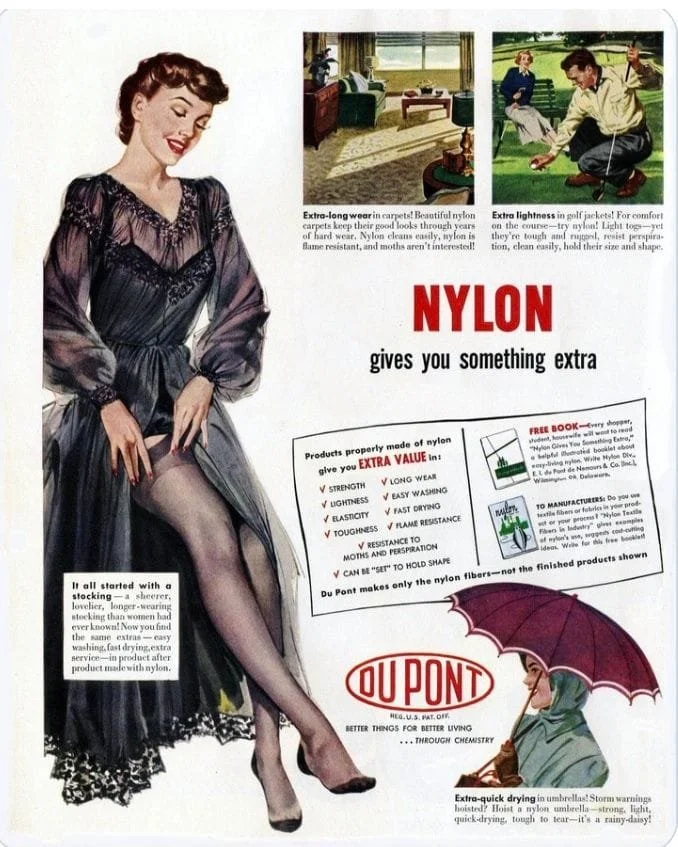
In 1939 DuPont introduced Nylon to the world, the first fabric made entirely from petrochemicals. Subsequently, other synthetics emerged, including polyester (1946), acrylic (1955), and spandex (1958).
By the 1950s their use was already up to 20%.
Synthetics are cheaper to produce, which makes them an appealing material of choice for the fashion industry. This cheap cost of production led to their near-ubiquitous use in fast fashion and most other industries that use textiles. We have not been using these fibers for very long, nor have the long-term effects of wearing petrochemicals been extensively studied. Their popularity can attest to the corporate greed of profit over health and the environment. We would rather have new, disposable, and cheap over the natural, the repairable, and the durable.
How did we become so duped to want to cover ourselves with plastic?
So how are these synthetics made?
Polyester is cheap to produce and makes you look cheap, yet the environmental and health consequences are costly.
Let’s start with Polyester. According to the CFDA, polyester is the most used fiber in the world, its use makes up over half of the fiber industry. Additionally, 80% of this synthetic usage is polyester.
Wearing polyester means wearing a plastic-type material derived from petroleum. Sounds great, doesn’t it?!
Each time polyester is washed it sheds micro-plastics into the water, polluting the air and water supply, and there is an extremely non-transparent supply chain. This means we have no idea where the oil was sourced, where the fibers were made, who produced the fabric, and then once you wear and wash your garment tiny particles shed into your local water and body.
If you are interested in the science of the production of polyester, here are some descriptions that I sourced from the internet.
1. Petroleum forms in nature over the course of millions of years.2. Petroleum is extracted from the earth with giant drilling machines and treated.
3. Petroleum is transported to refineries (by truck, ship, tanker, or pipeline) where heat, fuel, electricity, high pressure, solvents, and catalysts are used to break down the molecules into useful ingredients. This process is also referred to as “cracking”. Many petrochemical products can be derived from petroleum at refineries, but ethylene and p-xylene are the monomers used for the polyester production. Ethylene is then broken down even more using heating, cooling, pressure, water, and sometimes a catalyst to produce raw materials useful for polyester production, in particular ethylene glycol. The two main acids used in the production of polyester are dimethyl terephthalate (DMT) and terephthalic acid (TPA), organic compounds produced from P-xylene. Both DMT and TPA are stored in molten form and transported in tanks from refineries.
4. PET (polyethylene terephthalate, the same type of plastic used in plastic soda bottles) is formed through a process of polymerization in which ethylene glycol, TPA, and (depending on the process) DMT are combined using heat and high pressure. The result is a liquid of honey-like consistency that is extruded, dried, and chopped up to make plastic pellets.
5. To make polyester fibers, PET plastic pellets are melted and extruded through tiny holes called spinnerets to form long threads, which are then cooled to harden into a fiber. This process is called melt spinning. The shape and qualtity of holes can be altered to create fibers with different qualities. These fibers are twisted together to create polyester yarn and wound onto bobbins, where they are ready to be woven into fabric. -CFDA
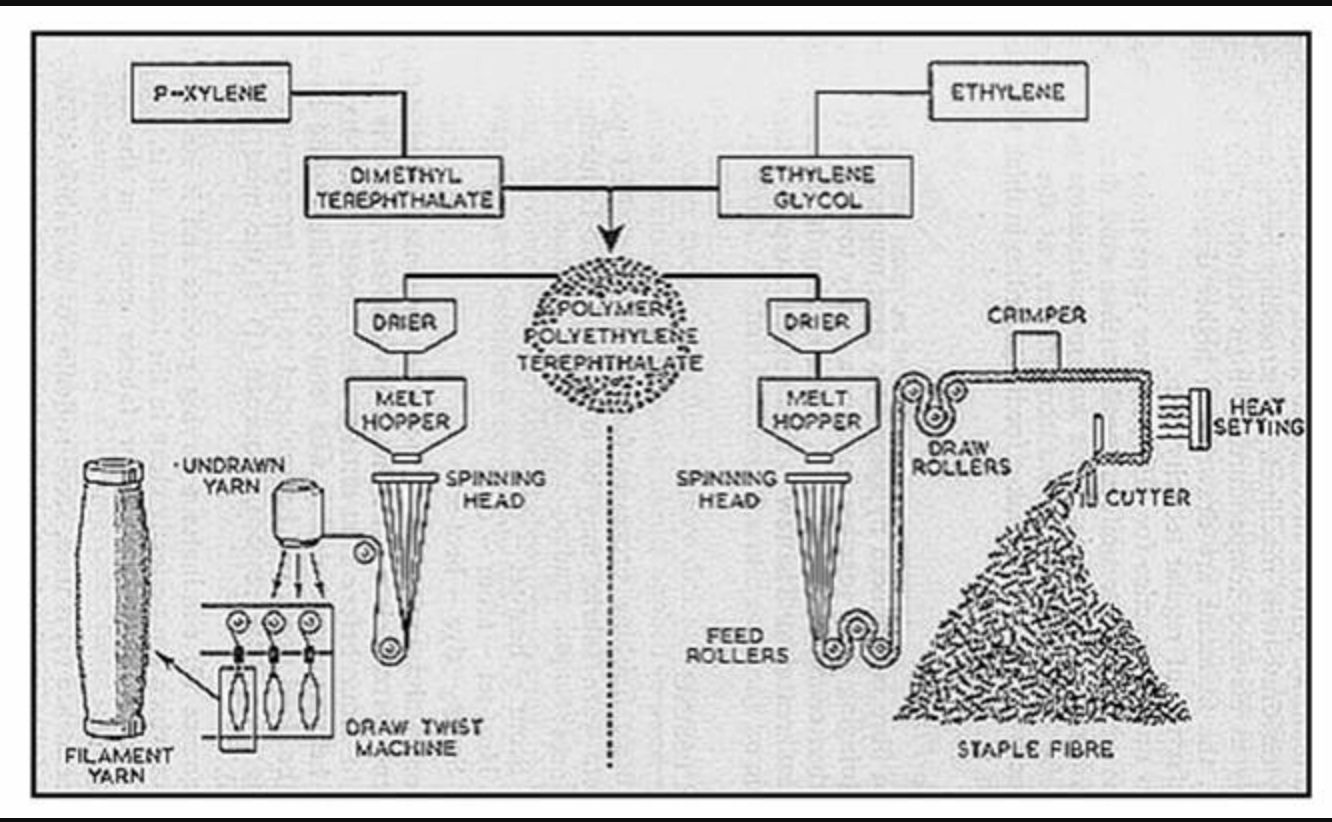
Polyester fiber production chart
“Polyester fibres are synthetic textile fibres formed by condensation polymerization of two monomers: dicarboxylic acid or terephthalic acid and ethylene glycol. Terephthalic acid is obtained by oxidizing para-xylene and nitric acid at 200ºC using cobalt toluate as catalyst. Para-xylene is derived from petroleum during polymerization. It is a component in the production of terephthalic acid for polyesters such as polyethylene terephthalate. Xylene has been shown to have toxic effects [20-27]. If terephthalic acid is being used then hydrochloric acid is added as catalyst. If diethyl terephthalate is used, then sodium is added as catalyst. Both terephthalic acid and ethylene glycol are known carcinogens. Since the monomers are toxic, the toxicity of their polymerization product should not be ignored.”
Polyethylene Terephthalate (PET)
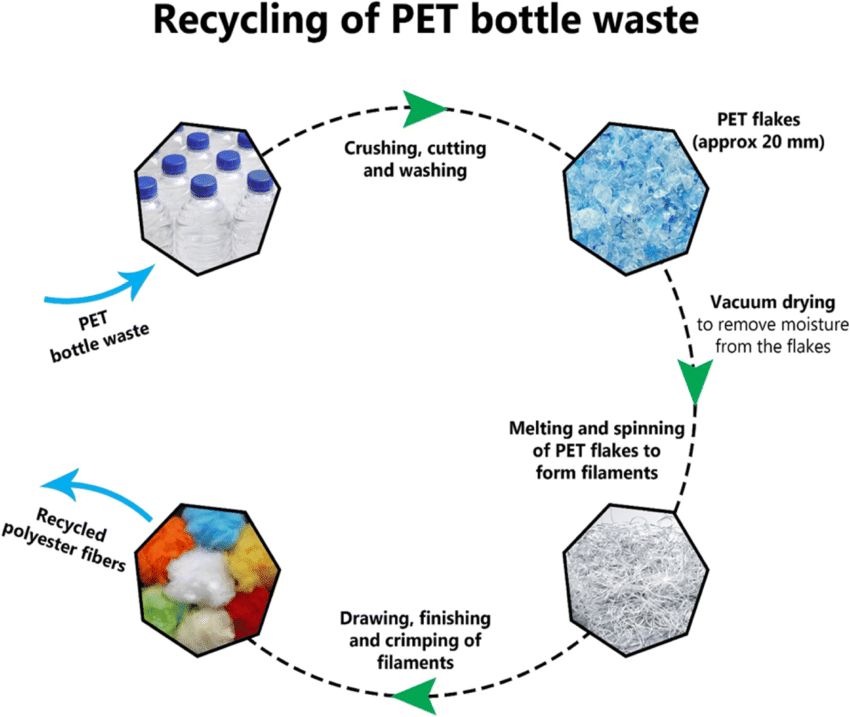
To synthesize, PET is basically the same plastic as disposable water bottles, and 60% of PET’s global production goes to making polyester, not those bottles. Or these bottles go to the recycling center to be shredded, then sent off typically to China to be chemically extracted to then make “recycled polyester,” a trendy greenwashed term. PET is not biodegradable, but it does break down. Eventually, these cheap garments end up in landfills once their lifespan is complete, releasing microplastics and toxic chemical byproducts back into the environment.
Health concerns over PET include: The leeching of Phthalates. Phthalates are known endocrine disruptors and testosterone reducers.
“Phthalates are linked with negative effects such as endocrine and reproductive disregulation, early puberty, endometriosis, and infertility.”
-Giuliani, A., Zuccarini, M., Cichelli, A., Khan, H., & Reale, M. (2020). Critical Review on the Presence of Phthalates in Food and Evidence of Their Biological Impact. International Journal of Environmental Research and Public Health, 17(16). https://doi.org/10.3390/ijerph17165655
When plastics are heated they leech, which means that the microplastics & chemicals leech into your skin, your largest organ. These chemicals typically are estrogen mimickers. Currently, there are no published scientific studies about leeching polyester chemicals entering the body via skin contact. So we basically have leeching water bottles on our bodies when we wear PET-containing Phthalate leeching polyester.
We can deduce as is the case when plastic water bottles are heated, they leech chemicals into the water, are our bodies not the same? Our bodies are warm, therefore, the chemicals present on & within the synthetic fibers enter our bodies, especially when used during exercise. Plastic bottles when heated release acetaldehyde, which is a known carcinogen, and DNA damager. A quick search for the dangers of acetaldehyde quickly reveals informational pamphlets about what to do in case of exposure!
So now here we are Polyester, which in its production, is made up of PET- releases Phthalates, Phytoestrogens, & Acetaldehyde
Our skin is our largest organ
Our skin is our largest organ, it eliminates and absorbs. We eliminate sweat and absorb vitamin D all through our skin. Skin can function best when it can breathe and effectively regulate our body’s temperature. Our skin absorbs what we place on it and what goes on our skin ends up in our body. Polyester and other synthetic fabrics are poor conductors of heat. They do not allow the skin to breathe and they trap sweat. These fabrics are not optimal choices for any of us, especially in warm conditions such as exercise.
To summarize some of the chemicals in each material that is then placed on our skin:
Polyester
Composed of ingredients such as dimethyl ester dimethyl terephthalate (DMT), monoethylene glycol (MEG), and purified terephthalic acid (PTS). Contains known carcinogens. Releases Phytoestrogens and Endocrine Disruptors. Can cause acute and chronic respiratory infections. Lowers sperm count and affects sex drive.
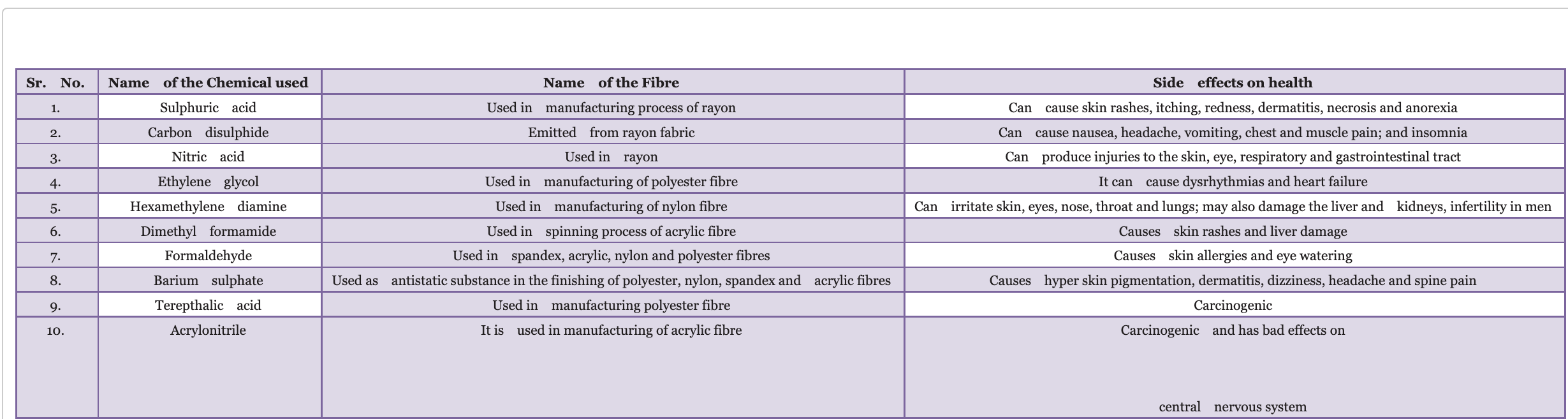
Contains: Ethylene Glycol, Terephthalic Acid, and Formaldehyde See chart below
Nylon- Common in Swim & Activewear, stretchy
Off gasses toxins, such as Nitrous Oxide.
Contains: Hexamethylene Diamine, Formaldehyde, Titanium Oxide, & Barium Sulphate See chart
Acrylic- Mimics Wool
Made from super toxic substances. Emits toxic fumes.
Contains: Acrylonitrile, Dimethyl Formamide, Barium Sulphate See chart
Synthetic Fabrics Causing Infertility?
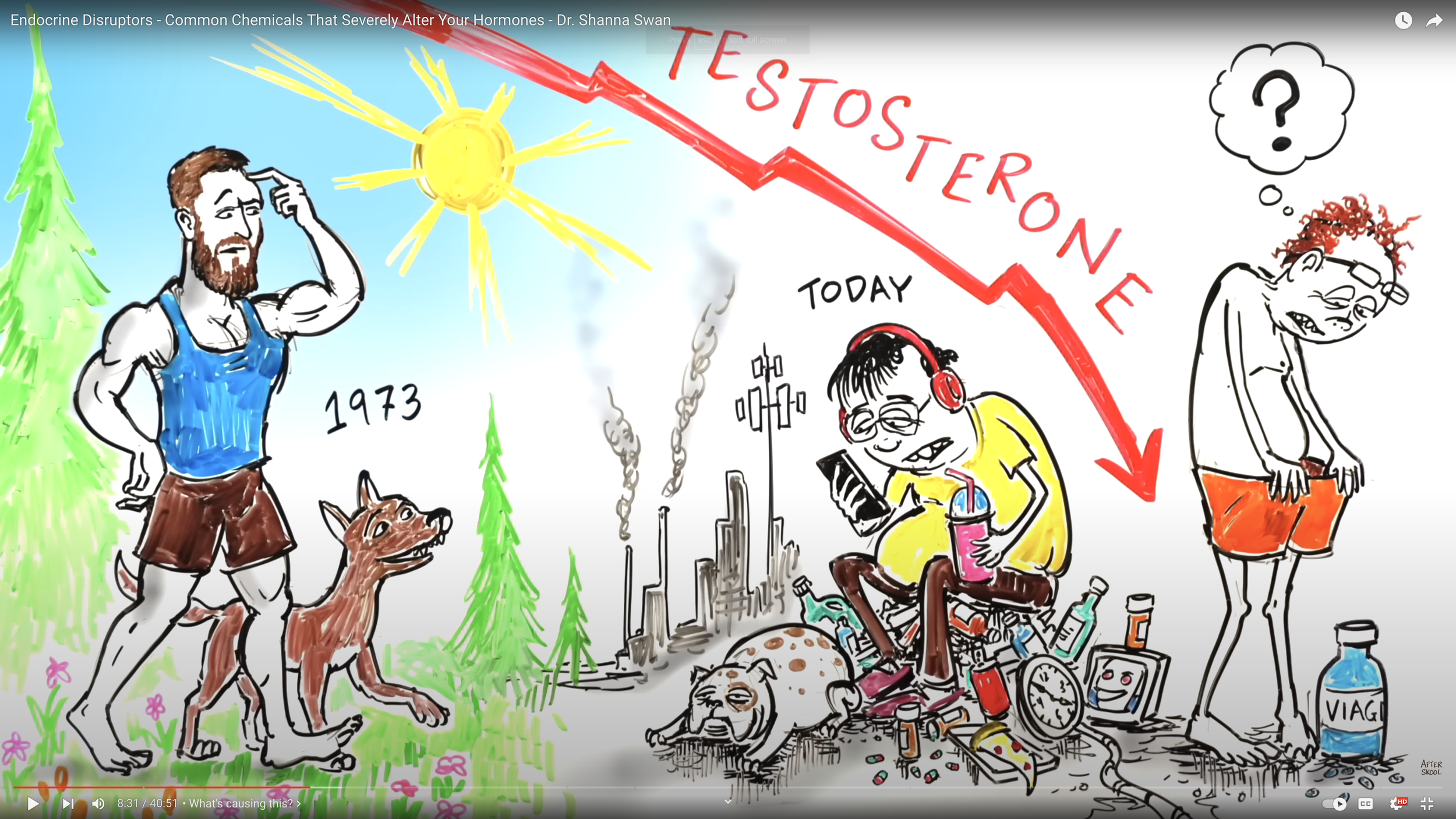
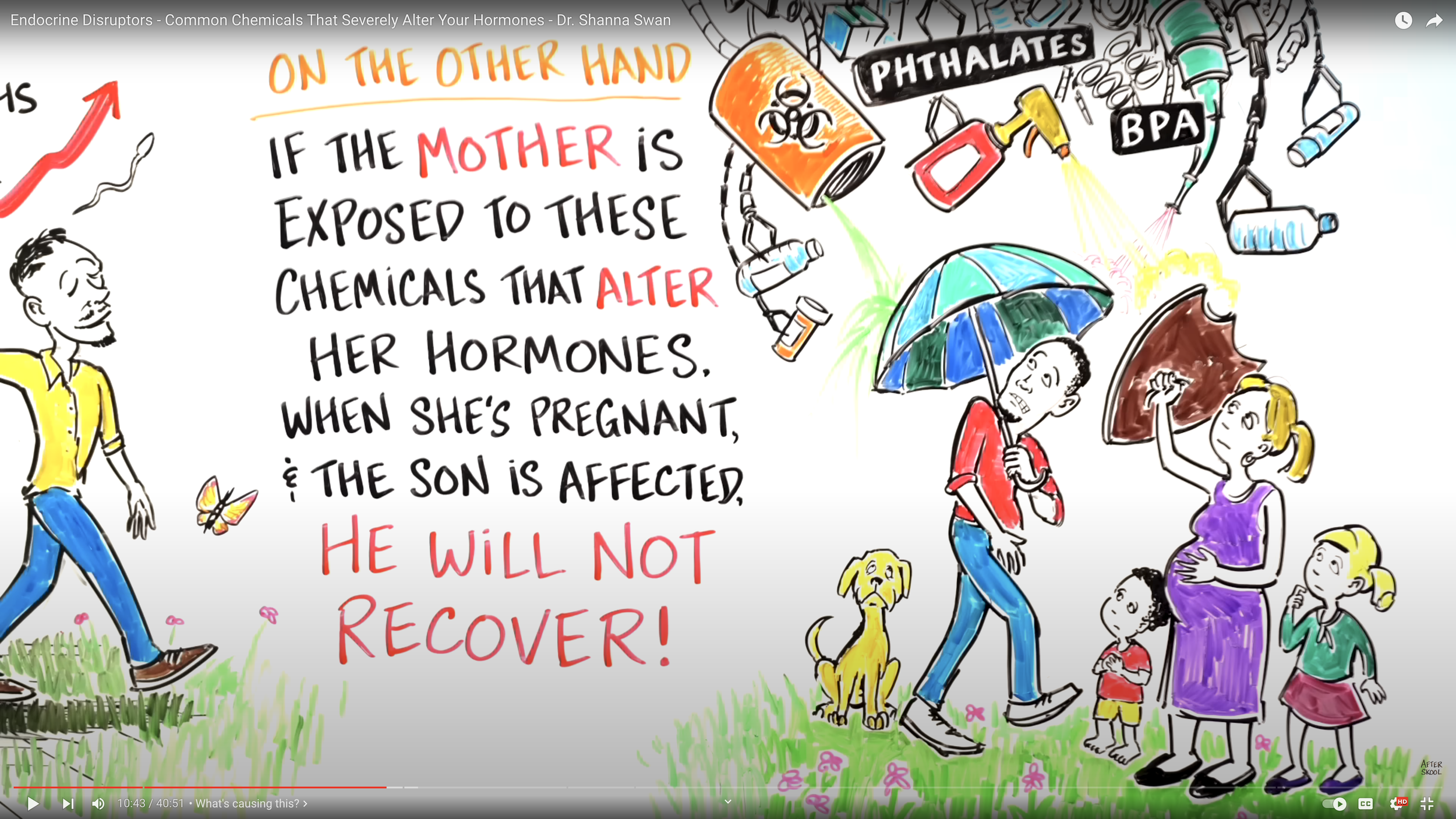
A recent After Skool YouTube video featuring Dr. Shanna Swan discusses Phthalates, and their dire implications on sperm count, testosterone, and our dwindling fertility crisis. The video discusses how sperm counts and testosterone levels have been steadily decreasing at a new rate of 2.6% per year. She raises the alarm about how before reproduction was a basic human right, but now people might not even receive this right due to this decrease. She comments on our dependency on plastics leading to this decline. She fails to mention the omnipresence of Synthetic fibers and clothing in our lives as a culprit. Instead, she mentions all the other sources of plastics & endocrine disruptors, such as plastic bottles, artificial fragrances & cosmetics, and pesticides. All of these are valid points, they are toxic and everywhere, but clothing is something we are exposed to day in and day out that rests directly atop our skin!
There have been additional studies conducted that show the wearing of polyester around the male genitalia in the form of a sling is an effective form of contraception. Of the 14 males tested all 14 were rendered sterile from wearing a polyester sling. This sterility was however reversible.
-SeeShafik A. Contraceptive efficacy of polyester-induced azoospermia in normal men. Contraception. 1992 May
Furthermore, there was a study conducted with dogs wearing polyester underwear vs. cotton. This study found that the dogs that wore the polyester underwear had a detectable lowering of sperm count. They could not conclude what caused the effect of the lowered sperm via the polyester, but they assume it was due to the electrostatic charge.
-See Shafik A. Effect of different types of textile fabric on spermatogenesis: an experimental study. Urol Res. 1993
This is just the tip of the iceberg to the hypothesis that yes. Synthetic fabrics could lead to infertility issues. I will need to do a follow-up once more research is conducted.
Each chemical and consequence I research for this post keeps leading me more and more into this rabbit hole of chemicals!
It is becoming a challenge to structure all of these points!
After researching, I feel that things pertaining to synthetic fabrics are significantly way worse than I originally thought. The list of consequences and dangers just seems to go on and on.
From Synthetic fibers, to each subsequent chemical contained in a specific synthetic material, to polyester, to then go into polyester’s fibers, then to the production, the chemical make-up, the chemicals released from chemical make-up to its dangers, then on to the next danger. It is an exhaustive list!
Because of this complex multi-faceted nature, this post will become a series of posts as I delve into the harmful complexities of the overlooked, synthetic fibers.
I knew wearing polyester was bad, but now that I conclude more research, I keep learning more about how terrible this is!